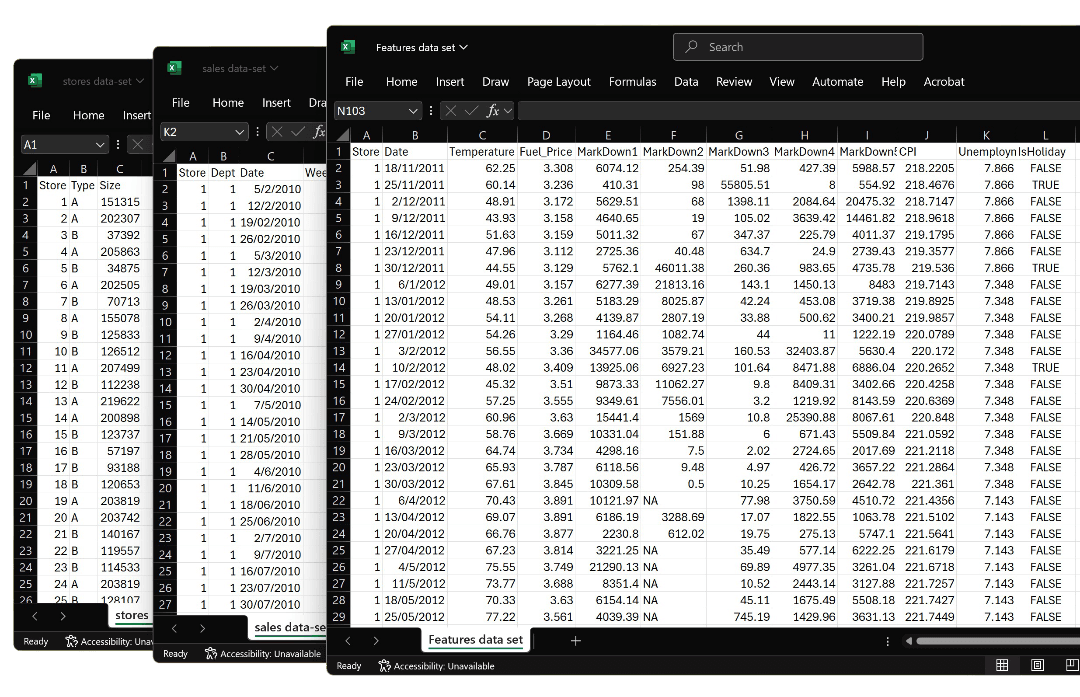
Turn Your Store Into a Data Goldmine: Consumer Analytics for Brick-and-Mortar Retailers
Customer analytics technology can help brick-and-mortar retailers increase sales by 15-25%, reduce inventory costs by 5-20%, and improve operational efficiency—all while creating better customer experiences.
Turn Your Store Into a Data Goldmine: Consumer Analytics for Brick-and-Mortar Retailers
TL;DR: Customer analytics technology can help brick-and-mortar retailers increase sales by 15-25%, reduce inventory costs by 5-20%, and improve operational efficiency—all while creating better customer experiences. Simple tracking systems and smart data analysis turn guesswork into profitable decisions.
The $50,000 Monday Morning Problem
Picture this: It's Monday morning, and you're staring at your weekend sales reports. Your premium electronics section had tons of foot traffic but few sales, while your clearance area in the back corner somehow moved twice as much inventory. Meanwhile, your competitor down the street just announced a 30% increase in quarterly revenue, and you're wondering what they know that you don't.
Here's what they likely know: The global data analytics in retail market size was valued at $4.3 billion in 2020 and is projected to reach $11.1 billion by 2025, growing at a CAGR of 21.2%. More importantly, they're probably using customer analytics to make decisions based on real behavior data rather than gut instinct.
What Is Customer Analytics (And Why It's Not As Complicated As It Sounds)
Think of customer analytics as having a super-smart assistant who watches your store 24/7 and remembers everything. This assistant notices that customers who browse for more than 8 minutes usually buy something, that Tuesday afternoons are dead zones that could use better staffing, and that people always pick up that popular item near the checkout but rarely buy it unless it's discounted.
Customer analytics combines three simple data sources you probably already have: your point-of-sale system (what people buy), basic foot traffic tracking (when people visit), and customer interaction patterns (what they look at but don't buy). The magic happens when you connect these dots to understand not just what happened, but why it happened and what will likely happen next.
Instead of relying on "I think customers want this," analytics lets you say "I know customers who spend more than 10 minutes in the electronics section are 3x more likely to purchase if approached by staff within the first 3 minutes."
The Business Impact: Real Numbers, Real Profit
Immediate Revenue Boost
Strategic product placement can increase sales per square foot by 20-30% without changing inventory mix. For a typical small retailer with $500,000 in annual revenue, that's an extra $100,000-$150,000 per year just from putting the right products in the right places.
Proper staff positioning can increase conversion rates by 15-25%. A clothing store with $200,000 monthly revenue could see $30-50,000 additional monthly sales through optimized customer service timing.
Cost Savings That Add Up
10-20% improvement in forecast accuracy can lead to 5% reduction in the overall inventory costs. For a business carrying $100,000 in inventory, that's $5,000 in immediate cash flow improvement.
Analytics also eliminates expensive guesswork. Instead of ordering extra inventory "just in case," you order based on actual demand patterns. Instead of staffing for your busiest day every day, you staff based on predicted customer flow.
Competitive Advantage
While your competitors guess about customer preferences, you'll know them. While they react to problems after they happen, you'll prevent them. This isn't about becoming a tech company—it's about using technology to become a better retailer.
Practical Next Steps: What You Can Do This Week
Step 1: Start With What You Have
Log into your point-of-sale system and export last month's sales data by hour and day. Look for patterns: when are your busiest hours? What days have the highest average transaction values? This basic analysis costs nothing and often reveals surprising insights.
Step 2: Implement Simple Traffic Tracking
Install a basic people counter at your entrance (available for under $200). After two weeks, correlate this data with your sales figures to calculate your conversion rate. If 100 people visit but only 20 buy something, you have a 20% conversion rate—and a clear target for improvement.
Step 3: Map Customer Journeys
Spend a few hours this week simply observing and noting customer behavior: Where do people go first? What do they pick up but put back? Which areas do they avoid entirely? This manual observation will help you understand what data to focus on when you implement more sophisticated tracking.
Success Stories: Small Retailers Making Big Gains
The Vitamin Shoppe: From Guesswork to Smart Scheduling
The Vitamin Shoppe previously manually scheduled its store staff resulting in mismatched labor per shoppers. The brand subsequently started piping data into its scheduling tool, using RetailNext data as the main source for labor forecasts for approximately 3,500 employees in the field.
The results? Better customer service, improved staff productivity, and significant cost savings from matching labor to actual customer demand patterns.
Zara: Predictive Analytics Transforms Inventory
Zara observed a 20% reduction in its inventory costs and witnessed a 5% uptick in overall revenue by implementing cutting-edge tools that used machine learning algorithms to offer more dynamic, real-time solutions. They moved from traditional inventory systems based on past data to predictive models that consider multiple variables including real-time consumer behavior.
UK Retail Company: 50% Better Decision Making
Quantzig's retail performance analytics tools helped a UK-based retail company to achieve an increased insights consumption across the stakeholders by 50%, improved customer retention by 20%, and increased new customer acquisition by 10%. This demonstrates that even mid-sized retailers can see substantial improvements from implementing analytics.
The Reality Check: Start Small, Think Big
You don't need to transform your entire operation overnight. Start with a limited use case like optimizing a single campaign or analyzing one product category. Success breeds confidence, and confidence leads to bigger investments in analytics capabilities.
The most successful retailers view analytics not as a tech project, but as a way to become better at what they already do well: understanding and serving customers. Every small insight—like discovering that customers who browse for more than 5 minutes are twice as likely to buy—compounds into significant business improvements.
Your competitors who embrace analytics today will have a substantial advantage tomorrow. But here's the good news: most small retailers haven't started yet, which means there's still time to get ahead of the curve.
The question isn't whether customer analytics will transform retail—it already has. The question is whether you'll be leading that transformation or scrambling to catch up.
References
- Tredence. "Retail Customer Analytics - A Full Guide in 2025." August 30, 2022. https://www.tredence.com/blog/retail-customer-analytics
- Appinventiv. "10 Ways Retail Predictive Analytics Drives Growth in Business." May 1, 2025. https://appinventiv.com/blog/retail-predictive-analytics/
- RetailNext. "3 In-Store Analytics Case Studies Every Retailer Should Read." https://retailnext.net/blog/3-in-store-analytics-case-studies-every-retailer-should-read
- DigitalDefynd. "Top 10 Marketing Analytics Case Studies [2025]." June 24, 2025. https://digitaldefynd.com/IQ/marketing-analytics-case-studies/
- Quantzig. "Retail Performance Analytics: Ultimate Guide to gain Leverage in Marketing." February 18, 2025. https://www.quantzig.com/case-studies/retail-performance-analytics-ultimate-guide-to-gain-leverage-in-marketing/
- Retalon. "Unlocking Success with Retail Customer Analytics in 2025." January 6, 2025. https://retalon.com/blog/retail-customer-analytics